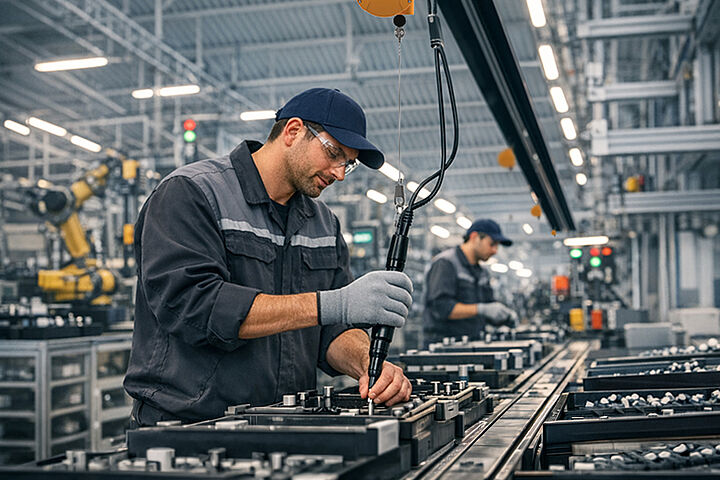
In ergonomic assessments of industrial workplaces, the focus is often placed on heavy tools and obvious loads. Far less attention is paid to light hand tools weighing less than 2 kg – even though they are used continuously in daily assembly work. Especially during repetitive tasks, frequently performed at chest or shoulder height, relevant physical strain can develop over the duration of a full shift.
Occupational science statistics show that this type of strain is far from a marginal issue. Musculoskeletal disorders are among the most common causes of work incapacity in Germany, accounting for around 20 % of all sickness‑related absence days. At a European level, according to EU‑OSHA, they represent the most widespread work‑related health problem across all industries. A key characteristic is that many of these burdens do not arise suddenly, but develop gradually from everyday, seemingly light tasks.
In manual assembly processes with high cycle rates, this cumulative strain often remains unnoticed for a long time – until fatigue, reduced precision or recurring discomfort become apparent
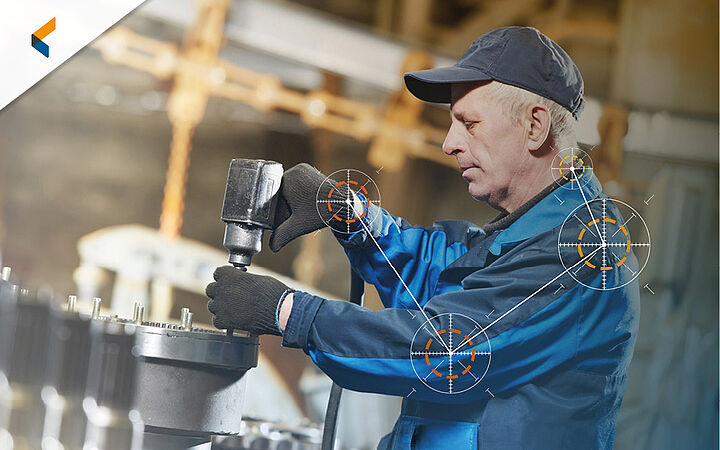
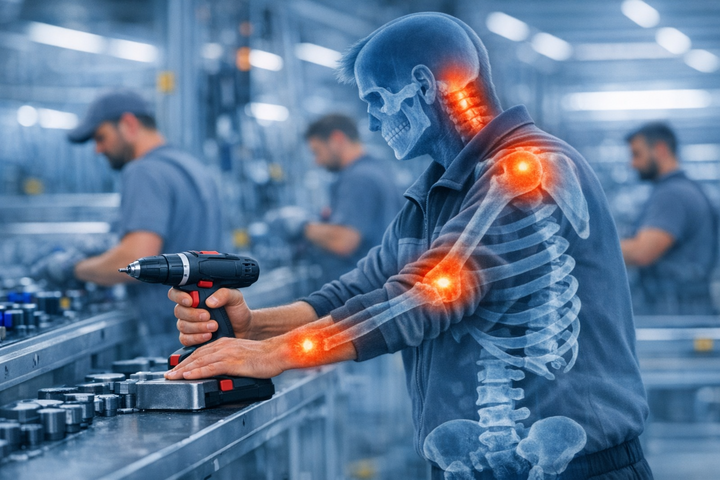
The decisive factor is not the tool weight alone, but its distance from the body. When a tool is guided away from the body, lever arms are created that significantly increase the torque acting on joints. To compensate for these torques, muscles must generate forces that exceed the actual tool weight by several times. A simplified calculation example illustrates this relationship.
The following analysis is based on a simplified biomechanical lever model and serves to realistically classify orders of magnitude.
|
|
|
|
|
|
|
Wrist |
0,08 |
1,6 |
≈ 105 |
≈ 10–11 |
Slightly increased during positioning and fine movements |
|
Elbow |
0,35 |
7,0 |
≈ 175 |
≈ 17–18 |
Additional forces during forward/backward movements |
|
Shoulder |
0,60 |
12,0 |
≈ 240 |
≈ 23–24 |
Significantly higher load when lifting, lowering or guiding |
|
Neck/ Cervical spine |
0,60 |
7,0 |
> 330 |
> 33 |
Dynamics and visual stabilization further increase the load |

The static holding load does not represent the worst‑case scenario, but rather the lower bound of loading conditions. Real tool movements generate additional dynamic forces. The calculation describes a momentary load during pure holding of the tool. This load does not occur once, but hundreds of times per shift. The values shown are therefore realistic, yet conservative. Even a 2 kg tool can lead to internal loads exceeding 30 kg.
These loads have measurable effects. Musculoskeletal disorders not only account for a significant share of absence days, but are also disproportionately associated with long periods of incapacity. According to data from the Scientific Institute of the AOK (WIdO), nearly 20 % of all sickness absence days are attributable to disorders of the musculoskeletal system, with high relevance for long‑term conditions.
From an economic perspective, the impact is substantial. The German Federal Institute for Occupational Safety and Health (BAuA) estimates production losses due to sickness‑related absence at around €128 billion per year, with losses in gross value added exceeding €220 billion. Musculoskeletal disorders contribute disproportionately to these figures due to their recurring and often chronic nature.
In addition to direct absence costs, indirect effects arise such as reduced performance due to fatigue, increased error and rework rates, higher accident risks caused by declining concentration, and the long‑term loss of experienced skilled workers. EU‑OSHA identifies repetitive movements, static holding work and tasks in the shoulder and chest region as key biomechanical risk factors.
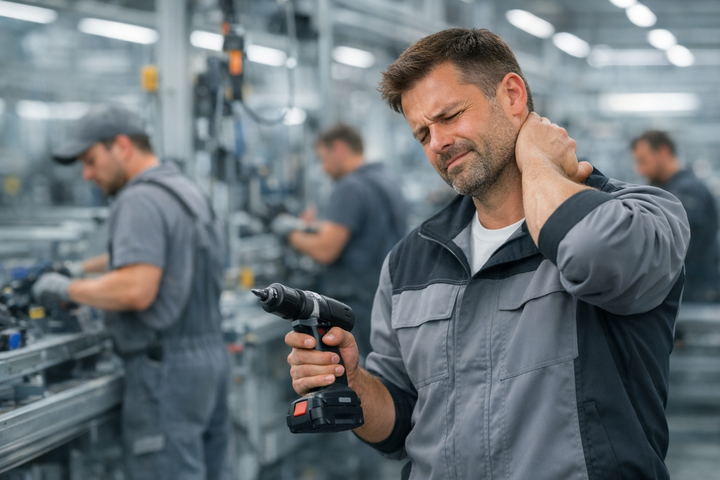
In ergonomic assessments, the distinction between “light” and “heavy” loads is of limited value. What matters is the resulting internal joint and muscle load, which is determined by weight, lever arm, posture, dynamics and repetition. Even small external loads can therefore lead to significant cumulative strain. To address these stresses effectively, complex automation solutions are not necessarily required. In many manual assembly applications, mechanical weight compensation offers a targeted and economically viable approach.
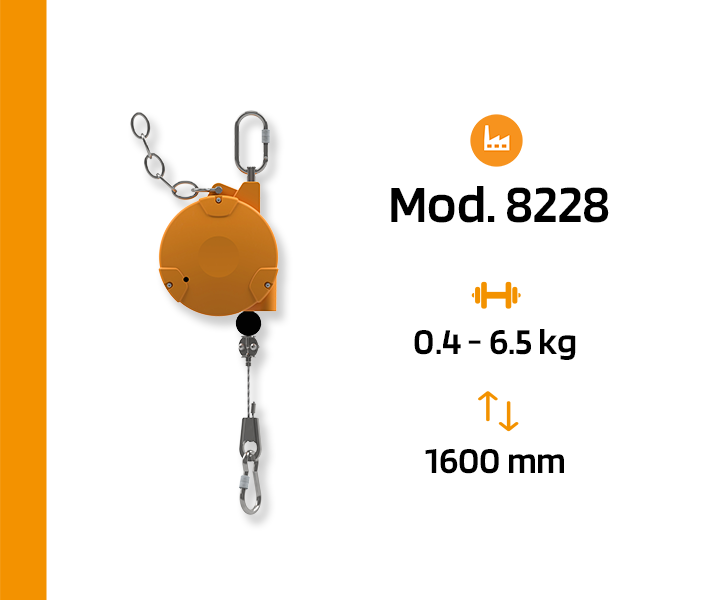
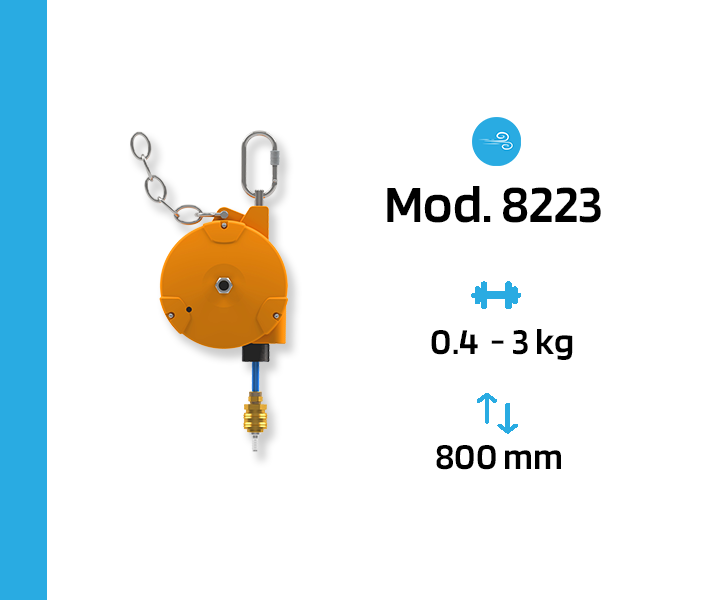
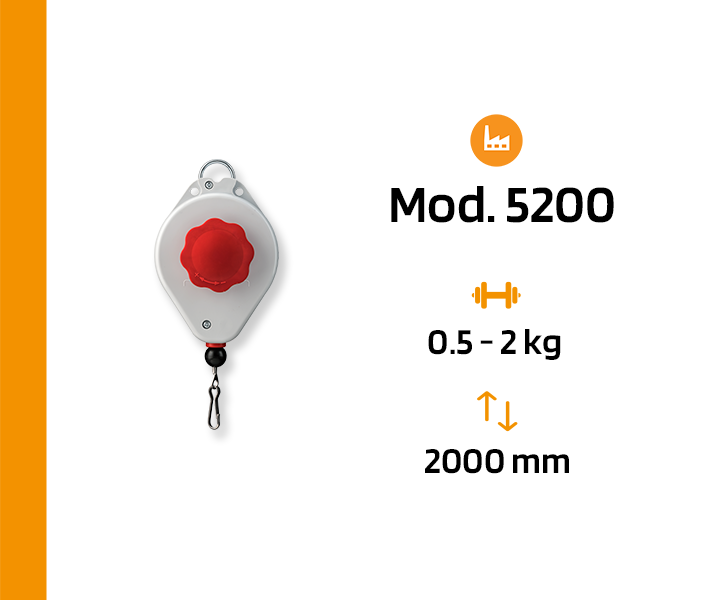
The analysis clearly shows that ergonomic strain in assembly is not primarily caused by high tool weights, but by lever effects, posture and repetition. This is exactly where mechanical weight compensation comes into play. Balancers neutralize the tool weight almost completely, directly reducing the forces acting on wrists, elbows, shoulders and the neck at their point of origin.
The required muscle effort decreases significantly, while mobility, control and precision are maintained. Tools can be guided in a controlled manner without constantly having to counteract their own weight. At the same time, the defined return of tools to a rest position supports workplace organization and reduces accident and wear risks.
As purely mechanical, energy‑independent and low‑maintenance systems, balancers can be easily integrated into existing assembly workstations. Especially for light tools with constant weight, they provide an effective and economical way to reduce cumulative strain and sustainably stabilize manual assembly processes.